

Gold Ore Beneficiation Production Line | Complete Process & Technical Solution
Release time:
2026-05-07
Source:
GoFine
Gold ore beneficiation is a critical link in gold extraction, directly determining the recovery rate of gold, production efficiency, and economic benefits of mining projects. A well-designed gold ore beneficiation production line integrates professional equipment, scientific process layout, and optimized technical parameters to convert raw gold ore into high-grade gold concentrate efficiently and environmentally friendly. Whether you are building a new gold beneficiation project or upgrading an existing production line, mastering the complete process and core technical solutions of the gold ore beneficiation production line is essential. This article will detail the entire process flow, key equipment configuration, technical optimization solutions, and common problems and solutions of the gold ore beneficiation production line, providing a comprehensive technical reference for mining enterprises and project investors.
What is a Gold Ore Beneficiation Production Line?
A gold ore beneficiation production line is a complete set of integrated production systems designed to separate gold minerals from raw gold ore and enrich them into high-grade gold concentrate. It covers multiple functional links, from raw ore pretreatment to final concentrate collection, and each link is closely connected to form a continuous and efficient production process. Unlike single beneficiation equipment, the gold ore beneficiation production line realizes automated and standardized operation through reasonable process design and equipment matching, which can adapt to different types of gold ore (such as rock gold, alluvial gold, oxidized gold ore, and sulfide gold ore) and different production scales.
The core goal of the gold ore beneficiation production line is to maximize the recovery rate of gold, reduce energy consumption and environmental pollution, and ensure the stability and consistency of product quality. With the continuous development of beneficiation technology, modern gold ore beneficiation production lines are increasingly intelligent, integrating advanced control systems and environmental protection technologies to meet the needs of green and efficient mining development.
Complete Process of Gold Ore Beneficiation Production Line
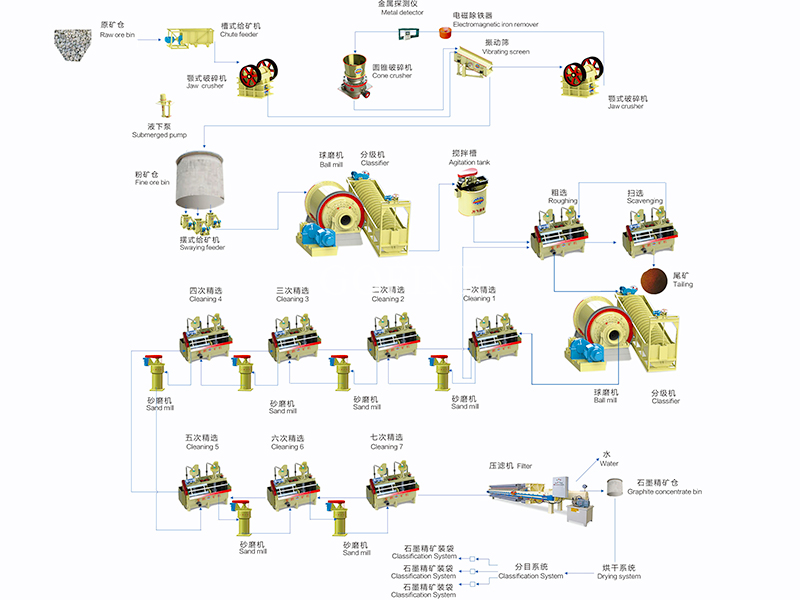
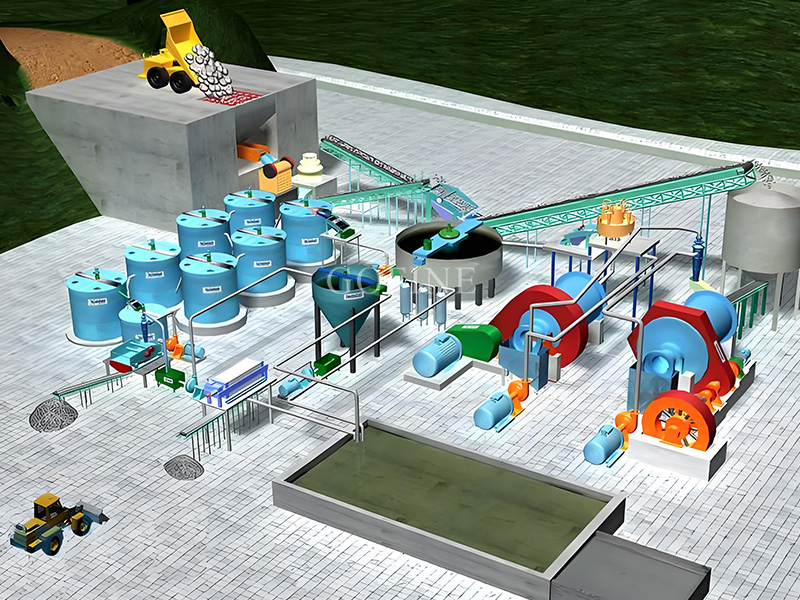
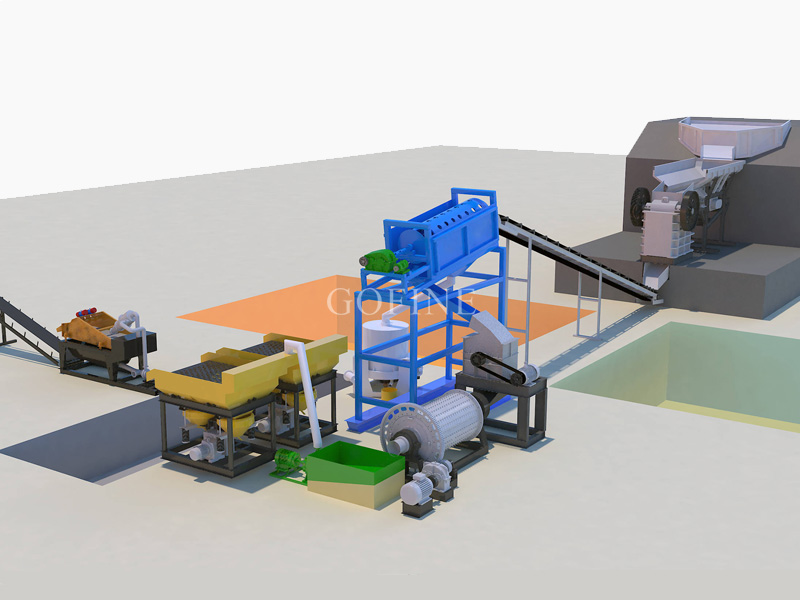
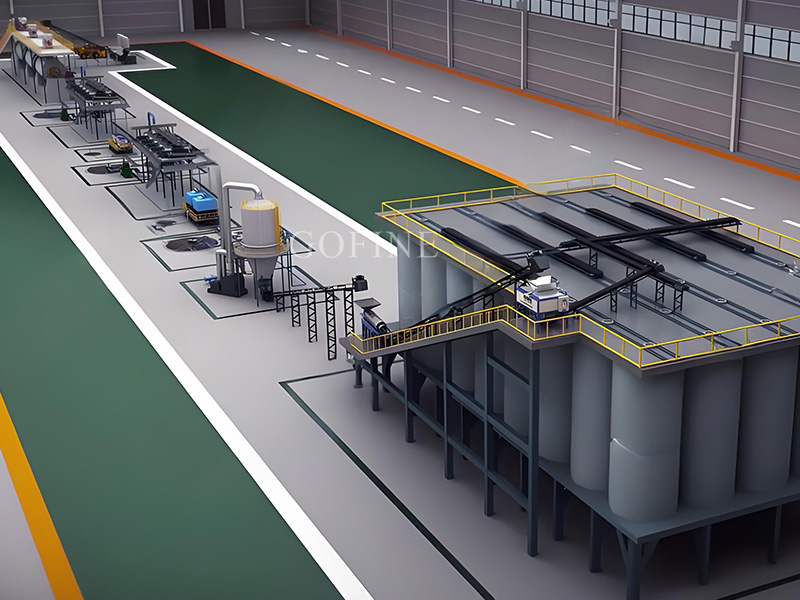
The process flow of the gold ore beneficiation production line varies according to the type of gold ore, gold occurrence state, and production scale, but the overall framework is consistent, mainly including four core links: raw ore pretreatment, grinding and classification, beneficiation separation, and concentrate dewatering. Below is a detailed introduction to each link:
1. Raw Ore Pretreatment: Lay the Foundation for Beneficiation
Raw ore pretreatment is the first step of the gold ore beneficiation production line, whose core purpose is to remove impurities in the raw ore, adjust the ore particle size, and create favorable conditions for subsequent grinding and beneficiation. The main processes include crushing, screening, and washing.
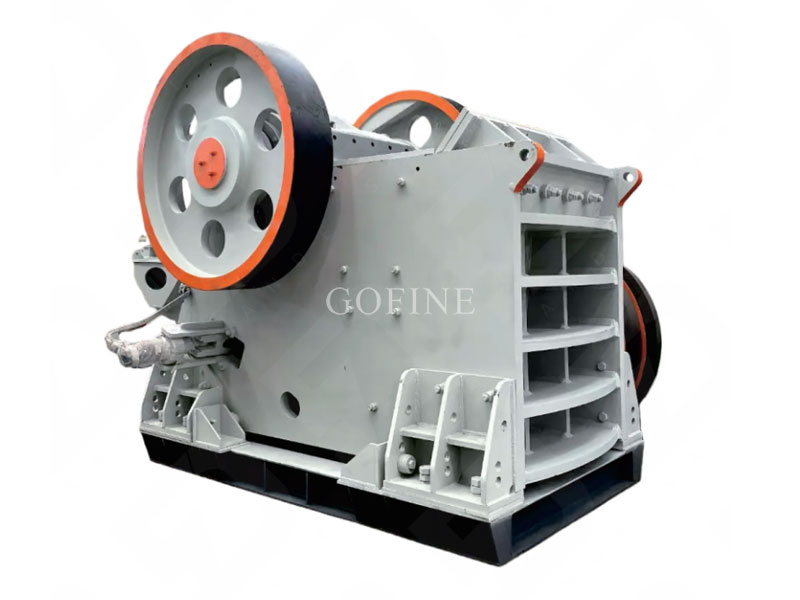
Crushing is to break large pieces of raw gold ore (with a particle size of 0.3-1.0m) into small particles through a three-stage closed-circuit crushing process. Coarse crushing uses a jaw crusher to break bulk ore into small particles; medium crushing uses a cone crusher to further reduce the ore particle size; fine crushing controls the feeding particle size of the ball mill within 10-20mm and pre-discards barren gangue without gold content. Screening is matched with the crusher to form a closed-circuit system, which screens the crushed ore into different particle sizes, and the unqualified coarse particles are returned to the crusher for re-crushing to ensure the uniformity of the ore particle size. Washing is mainly used for alluvial gold ore or gold ore with high mud content, which removes mud and impurities on the surface of the ore through a washing machine to avoid affecting the subsequent beneficiation effect.
2. Grinding and Classification: Realize Monomer Dissociation of Gold Minerals
Grinding and classification are the key links of the gold ore beneficiation production line, whose core goal is to grind the pretreated ore to the required fineness, so that gold minerals are fully dissociated from gangue minerals, and provide qualified materials for subsequent beneficiation separation. This link adopts a closed-circuit circulation system composed of a ball mill and a classifier.
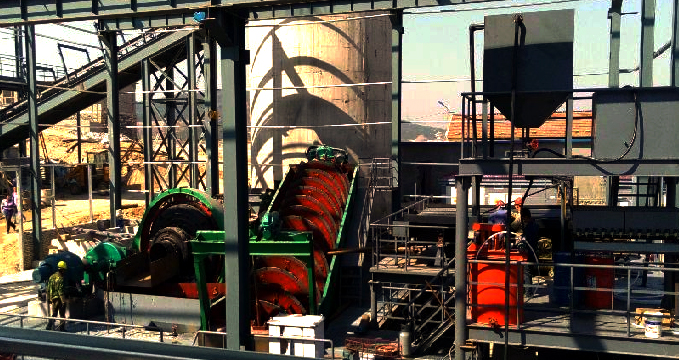
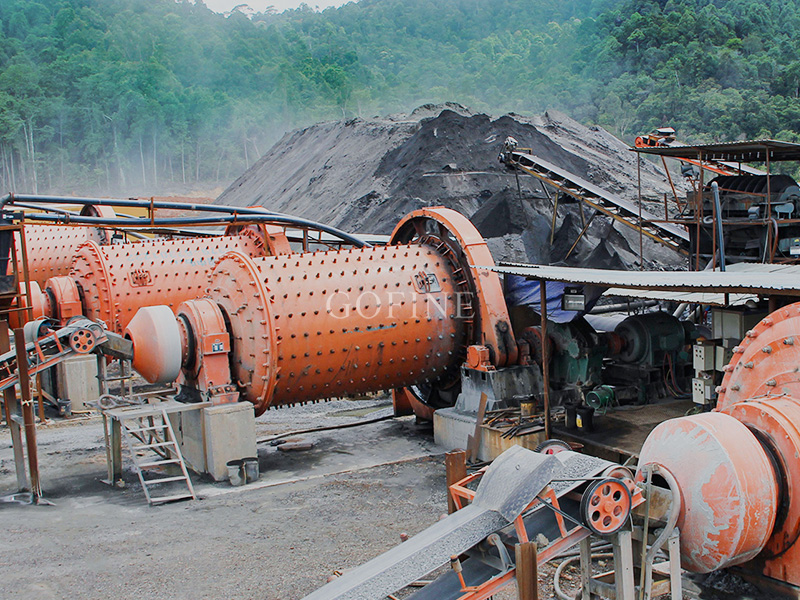
The ball mill is the core equipment of the grinding link. It grinds the ore to the target fineness through the impact and grinding effect of steel balls in the cylinder. According to the discharge method, it is divided into grid-type ball mill and overflow-type ball mill: grid-type ball mill has fast discharge speed and high grinding efficiency, which is suitable for coarse grinding process; overflow-type ball mill has finer discharge particle size and good grinding effect, which is suitable for fine grinding process. The classifier is used to classify the ground ore pulp. Qualified fine-grained ore is sent to the subsequent separation link, while coarse particles are returned to the ball mill for re-grinding. Common classifiers include spiral classifiers and hydrocyclones. Spiral classifiers are simple in structure and easy to maintain, suitable for small and medium-sized gold ore beneficiation production lines; hydrocyclones have high classification efficiency and small floor area, which are the mainstream choice for large-scale production lines.
The grinding fineness is closely related to the gold recovery rate. Generally, the fineness of oxidized gold ore needs to reach 60%-80% of -200 mesh, while sulfide gold ore and refractory gold ore need to reach more than 85% of -200 mesh to ensure the full dissociation of gold minerals.
3. Beneficiation Separation: Core Link of Gold Enrichment
Beneficiation separation is the core link of the gold ore beneficiation production line, which separates gold minerals from gangue minerals through different beneficiation methods according to the characteristics of gold ore, and enriches them into gold concentrate. The common beneficiation methods include gravity separation, flotation, and cyanidation (CIL/CIP), which can be used alone or in combination according to the ore properties.
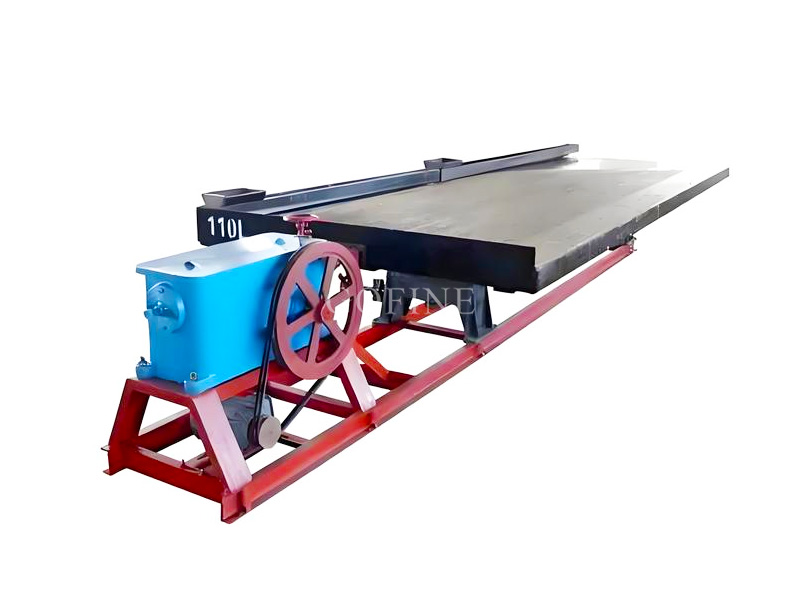
Gravity separation is mainly used to recover coarse-grained free gold (particle size > 0.074mm). It separates gold from gangue based on the density difference between gold and gangue under the action of gravity and centrifugal force. Common equipment includes jigs, shaking tables, and centrifugal separators. Gravity separation has the advantages of green environmental protection, low energy consumption, and simple operation, and is often used as a roughing link in the gold ore beneficiation production line to recover part of the gold in advance and reduce the load of subsequent processes.
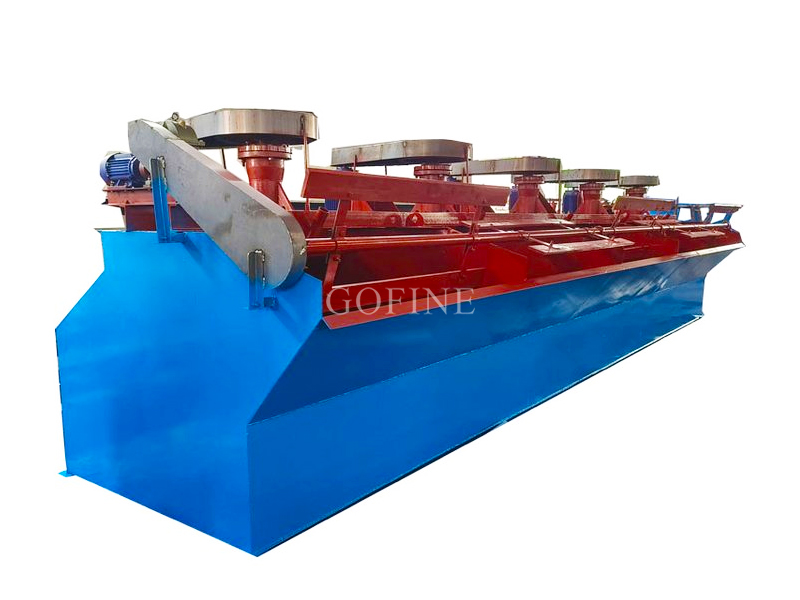
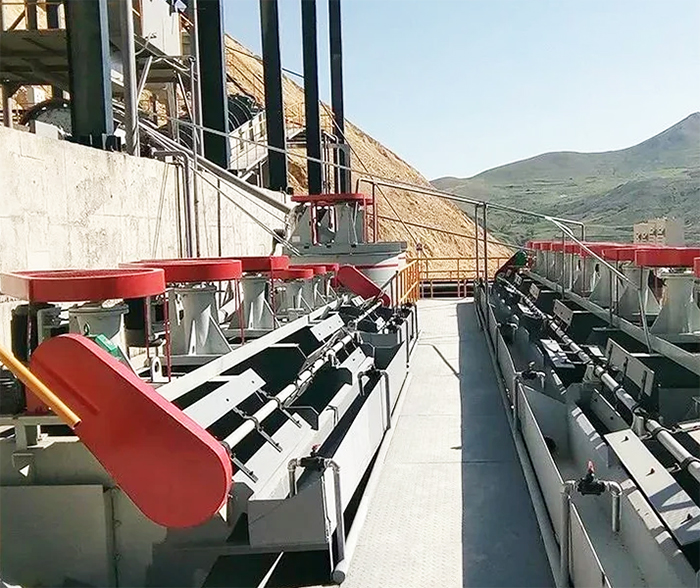
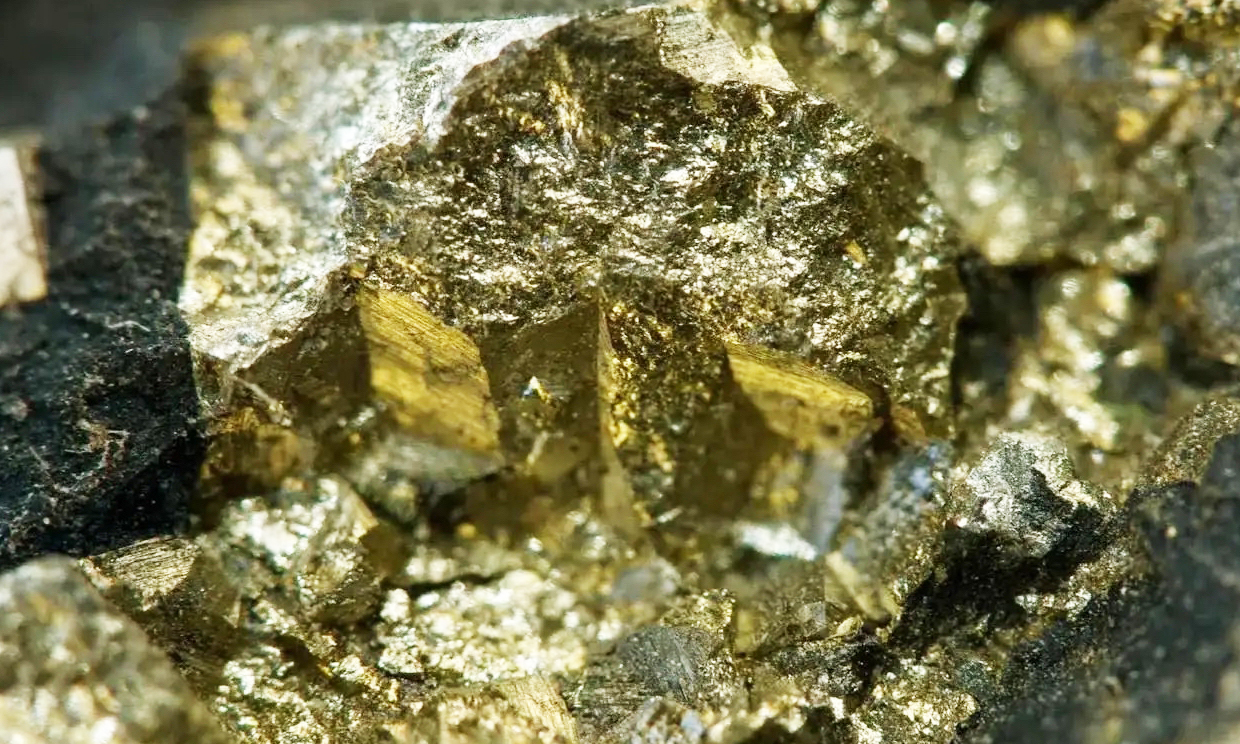
Flotation is suitable for recovering fine-grained and disseminated gold (particle size < 0.074mm), especially gold associated with sulfide minerals. It modifies the surface properties of gold minerals through collectors, frothers, and regulators, making them adhere to mineral foam and separate from gangue. The core equipment includes flotation machines, mixing tanks, and reagent adding equipment. The flotation process has high gold recovery rate (up to 80%-90%) and is the most widely used beneficiation method in modern gold ore beneficiation production lines.
Cyanidation (including CIL and CIP processes) is mainly used for the beneficiation of oxidized gold ore and fine-grained gold. It dissolves gold minerals into the solution through cyanide leaching solution, and then recovers gold from the solution through activated carbon adsorption, desorption electrolysis, and other links. The CIL process realizes leaching and adsorption in the same tank group, which is suitable for high-mud gold ore; the CIP process separates leaching and adsorption, which has high flexibility. This method has high gold recovery rate (up to 85%-95%) but requires strict environmental protection measures to avoid cyanide pollution.
4. Concentrate Dewatering: Obtain Qualified Gold Concentrate
The gold concentrate obtained after beneficiation separation contains a lot of water (moisture content of 30%-40%), which is not convenient for storage, transportation, and subsequent smelting. Therefore, concentrate dewatering is the final link of the gold ore beneficiation production line. The main processes include concentration, filtration, and drying.
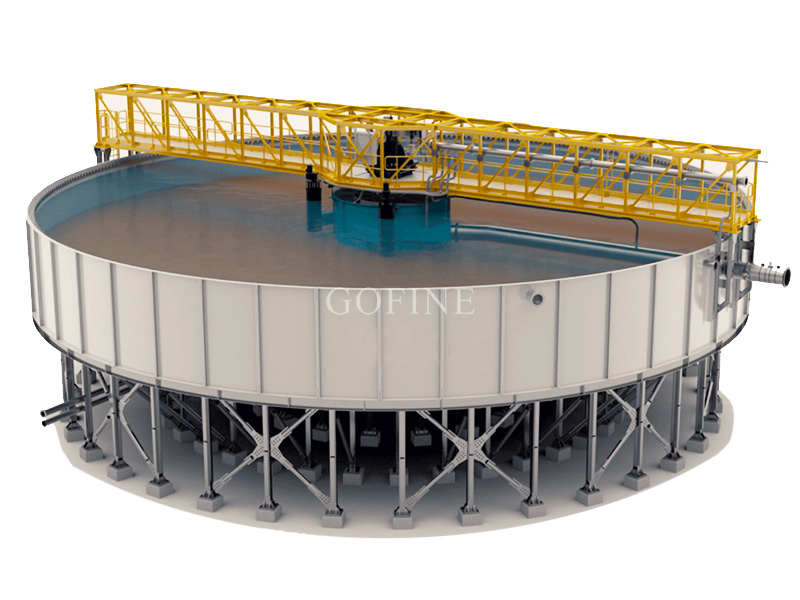
Concentration is to reduce the water content of the concentrate through a thickener, which uses the principle of gravity sedimentation to precipitate the concentrate particles and separate the water. Filtration is to further remove the moisture in the concentrated concentrate through a filter press or vacuum filter, reducing the moisture content to 15%-20%. Drying is to dry the filtered concentrate through a dryer, reducing the moisture content to below 10%, so as to obtain qualified gold concentrate that meets the smelting requirements.
Key Equipment Configuration of Gold Ore Beneficiation Production Line
The stable operation and beneficiation effect of the gold ore beneficiation production line depend on the rational configuration of key equipment. The equipment configuration needs to be combined with the ore type, production scale, and beneficiation process. The following are the core equipment and their functions in the production line:
1. Pretreatment Equipment
Jaw crusher: The “standard equipment” for coarse crushing of raw ore, which crushes large pieces of ore into medium-sized particles through the extrusion of the moving jaw and fixed jaw, with simple structure and low failure rate. Cone crusher: Used for medium and fine crushing, with high crushing efficiency and uniform product particle size, especially suitable for hard rock gold ore. Vibrating screen: Matched with the crusher to form a closed-circuit crushing system, which screens the crushed ore and returns unqualified coarse particles for re-crushing.
2. Grinding and Classification Equipment
Ball mill: The core equipment of the grinding link, which grinds the ore to the required fineness. Spiral classifier: A traditional classification equipment, simple in structure and easy to maintain, suitable for small and medium-sized production lines. Hydrocyclone: A modern classification equipment with high classification efficiency and small floor area, suitable for large-scale production lines.
3. Beneficiation Separation Equipment
Jig: Used for gravity separation roughing, suitable for recovering coarse-grained gold, with large processing capacity. Shaking table: Used for gravity separation cleaning, with high separation accuracy, suitable for recovering fine-grained gold. Flotation machine: The core equipment of the flotation process, which generates bubbles through stirring and aeration, making gold minerals adhere to the bubbles and separate from gangue. CIL/CIP equipment: Including leaching tanks, activated carbon adsorption tanks, desorption electrolysis systems, etc., used for cyanidation beneficiation.
4. Dewatering Equipment
Thickener: Used for concentrate concentration, reducing the water content of the concentrate. Filter press: Used for concentrate filtration, further removing moisture. Dryer: Used for concentrate drying, ensuring that the moisture content of the concentrate meets the requirements.
5. Intelligent Control System
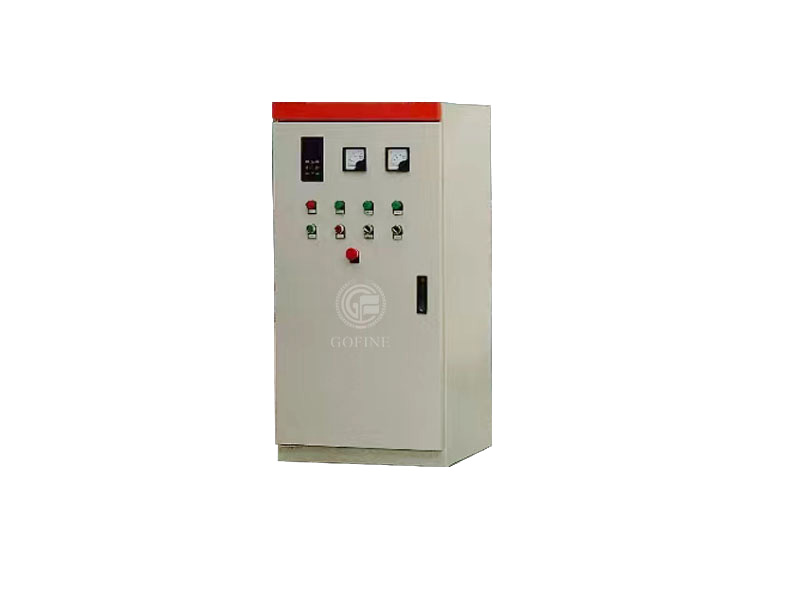
The modern gold ore beneficiation production line is equipped with an intelligent control system, which integrates PLC controllers, touch screens, and sensors. Operators can set production parameters through the touch screen, and the system automatically controls the operation of each equipment, realizes real-time monitoring of the production process, and issues alarms for abnormalities such as material blockage and temperature deviation, ensuring the safe and stable operation of the production line. The system also supports formula management, which can pre-set multiple beneficiation formulas and switch quickly according to the ore properties.
Technical Solutions for Gold Ore Beneficiation Production Line
Different types of gold ore have different physical and chemical properties, and the corresponding beneficiation technical solutions are also different. Below are targeted technical solutions for common gold ore types to help enterprises optimize the production line and improve the gold recovery rate:
1. Technical Solution for Rock Gold Ore
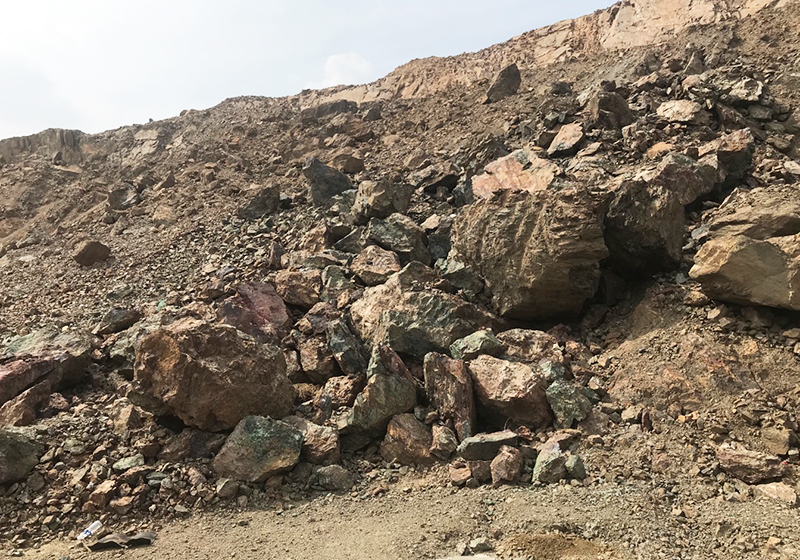
Rock gold ore is the main industrial gold resource, and gold mostly occurs as native gold in quartz veins with stable dissemination and simple associated components. The recommended technical solution is “crushing → grinding → flotation → cyanidation”, which combines flotation and cyanidation to maximize the gold recovery rate. For coarse-grained rock gold ore, a gravity separation link can be added before flotation to recover coarse-grained gold in advance, reducing the load of flotation. The grinding fineness should reach more than 85% of -200 mesh, and the flotation reagent should be reasonably matched according to the ore properties to improve the flotation effect. The cyanidation process adopts the CIL process, which realizes leaching and adsorption in the same tank group, reducing the production links and improving the production efficiency.
2. Technical Solution for Alluvial Gold Ore
Alluvial gold ore has the characteristics of fine particle size, high mud content, and easy separation. The recommended technical solution is “washing → screening → gravity separation”, which is green and environmentally friendly with low energy consumption. The washing link removes mud and impurities on the surface of the ore; the screening link separates the ore into different particle sizes; the gravity separation link uses jigs, shaking tables, and other equipment to recover gold. For fine-grained alluvial gold ore, a centrifugal concentrator can be added to improve the recovery rate of fine-grained gold. The key of the technical solution is to control the washing intensity and screening accuracy to avoid the loss of fine-grained gold.
3. Technical Solution for Refractory Gold Ore
Refractory gold ore (such as high-arsenic, high-sulfur, and high-carbon gold ore) has complex ore properties, and gold is wrapped in sulfide minerals or carbonaceous materials, making it difficult to dissociate and leach. The recommended technical solution is “pretreatment → grinding → flotation → cyanidation”. Pretreatment methods include roasting oxidation, bacterial oxidation, and pressure oxidation. Roasting oxidation decomposes sulfide and arsenic compounds at 750-850℃ to expose gold minerals; bacterial oxidation uses thermophilic bacteria to decompose minerals, which is environmentally friendly but has a long cycle; pressure oxidation oxidizes minerals under high temperature and pressure, with high efficiency but high equipment cost. After pretreatment, the ore is ground and floated to obtain gold concentrate, and then cyanidation is used to recover gold, which can improve the gold recovery rate to more than 85%.
Common Problems and Solutions in Gold Ore Beneficiation Production Line
In the actual operation of the gold ore beneficiation production line, various problems may occur, which affect the production efficiency and gold recovery rate. Below are common problems and corresponding solutions to help enterprises solve practical difficulties in production:
1. Low Gold Recovery Rate
Reasons: Insufficient grinding fineness, incomplete dissociation of gold minerals; unreasonable beneficiation reagent ratio; improper equipment operation parameters. Solutions: Adjust the grinding parameters to ensure that the gold minerals are fully dissociated; optimize the reagent ratio according to the ore properties, and adjust the dosage of collectors, frothers, and regulators; calibrate the equipment operation parameters, such as the rotation speed of the flotation machine and the feeding amount of the ball mill.
2. Unstable Product Quality
Reasons: Uneven particle size of raw ore; unstable operation of equipment; large fluctuation of ore properties. Solutions: Strengthen the pretreatment of raw ore to ensure uniform particle size; regularly maintain and calibrate the equipment to ensure stable operation; establish an ore testing mechanism, and adjust the beneficiation process and parameters in time according to the changes of ore properties.
3. High Energy Consumption
Reasons: Low equipment efficiency; unreasonable process layout; excessive grinding. Solutions: Replace inefficient equipment with energy-saving equipment, such as energy-saving ball mills and high-efficiency hydrocyclones; optimize the process layout to reduce the transportation distance of materials; control the grinding fineness reasonably to avoid excessive grinding and reduce energy consumption.
4. Environmental Pollution
Reasons: Unreasonable treatment of tailings and waste water; leakage of cyanide in the cyanidation process. Solutions: Equip a complete tailings treatment system, and recycle or harmlessly treat tailings; treat waste water through a sewage treatment system to meet the discharge standards; strengthen the sealing of the cyanidation equipment, and add a cyanide detoxification device to avoid cyanide leakage.
Conclusion
A gold ore beneficiation production line with a complete process and scientific technical solution is the key to realizing efficient and green gold extraction. From raw ore pretreatment to concentrate dewatering, each link needs to be strictly controlled, and the equipment configuration and technical parameters should be optimized according to the ore properties and production scale. Whether it is rock gold, alluvial gold, or refractory gold ore, only by selecting the appropriate beneficiation process and technical solution can the maximum gold recovery rate be achieved, and the production efficiency be improved while reducing energy consumption and environmental pollution.
With the continuous advancement of beneficiation technology, the gold ore beneficiation production line is developing towards intelligence, environmental protection, and efficiency. By integrating advanced equipment and control systems, optimizing the beneficiation process, and strengthening the daily operation and maintenance, mining enterprises can maximize the economic benefits of the gold ore beneficiation production line and promote the sustainable development of the gold mining industry. If you want to know more about the customization of the gold ore beneficiation production line and technical optimization, you can focus on our follow-up articles for more professional guidance.
Product Inquiry

Contact us
Address: Wulong Industrial Park, Xingyang City, Zhengzhou City, Henan Province
Contact:Richard
Phone:+86 151 3866 6240
Mail:richard@zzgofine.com
Online consultation
Copyright © 2027 All Rights Reserved.