
Impact Crusher
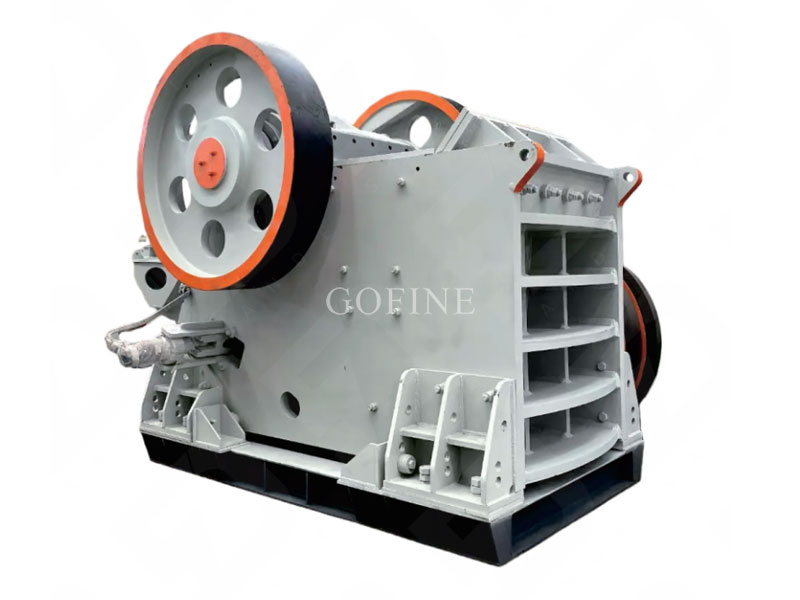
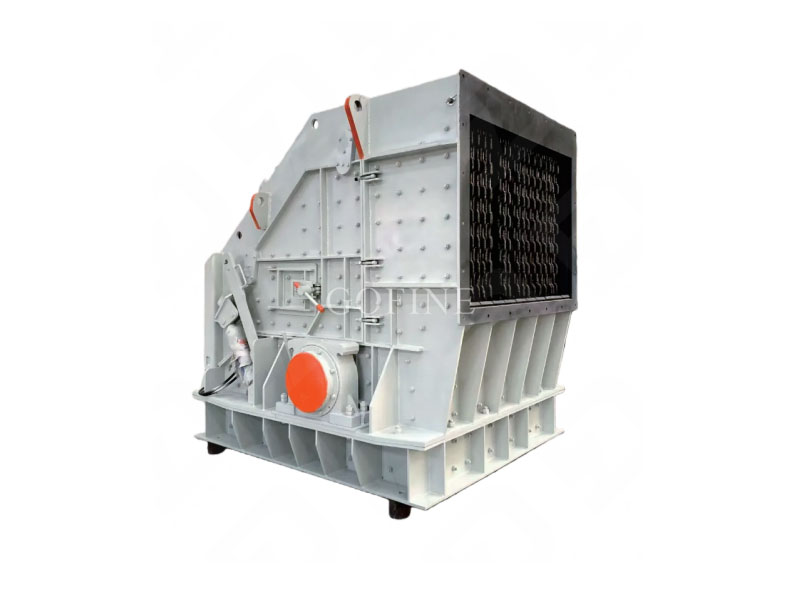
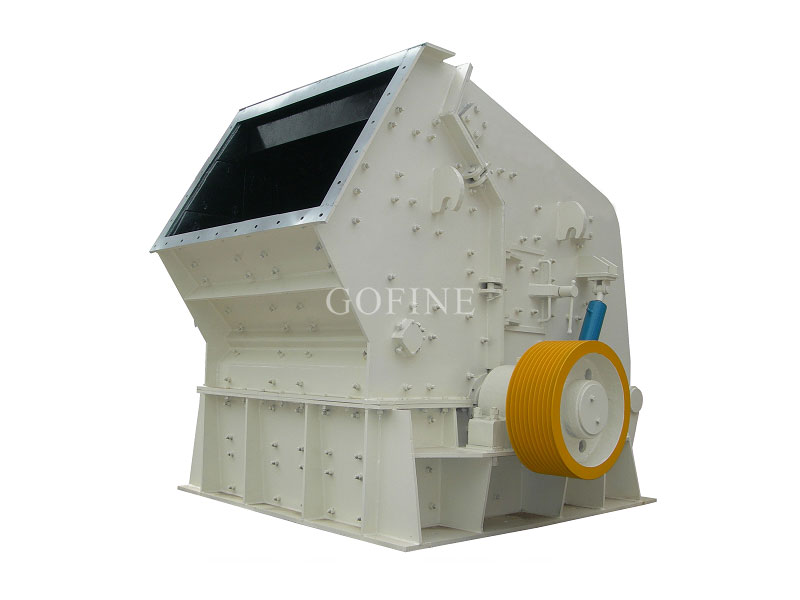
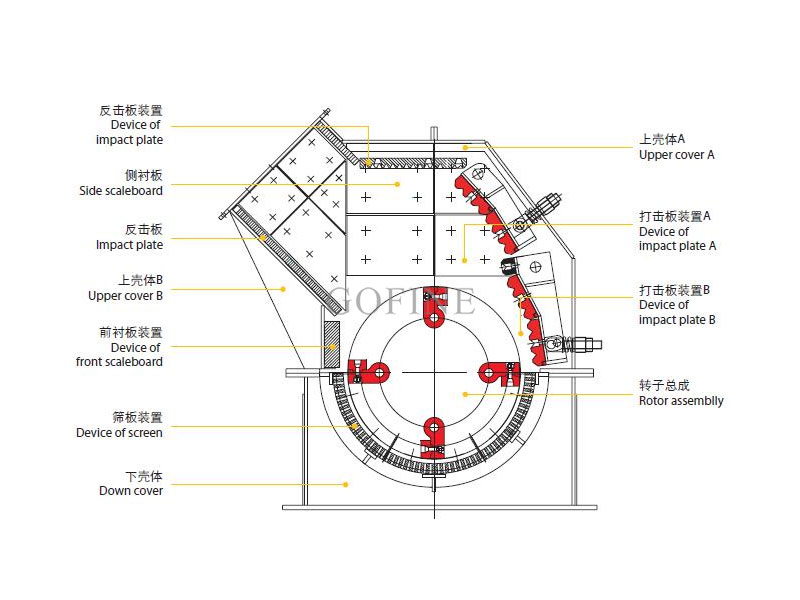
An impact crusher is a device that uses impact energy to crush materials. A motor drives a rotor to rotate at high speed, and hammer plates strike the material entering the crushing chamber. The material is thrown against the impact plates for secondary/multiple impacts and rebounds until the particle size meets the set requirements and is discharged from the outlet. The finished particle size can be precisely controlled by adjusting the gap between the impact plates and the rotor.
Working Principle:
The core principle of an impact crusher can be summarized as a multiple impact process of “stone against stone, stone against iron”:
High-speed impact: The motor drives the rotor to rotate at high speed. After the material enters, it is violently crushed by the hammer plates on the rotor.
Secondary impact: The impacted material is thrown at high speed against the impact plates on the machine body and crushed again.
Repeated crushing: The crushed material bounces back to the hammer impact zone, repeating the above process, forming a “material against material” vortex crushing.
Qualified discharge: When the particle size of the material is smaller than the gap between the hammers and the impact plates, it is discharged from the bottom of the machine, which is the finished product.
Equipment Advantages:
Excellent Output Particle Shape: The crushed material is predominantly cubic with low needle-like and flaky content, making it particularly suitable for applications requiring high aggregate shape (such as highway pavement aggregate).
Wide Range of Applicable Materials: It can process various ores (such as limestone, concrete, granite, etc.) with a side length not exceeding 500mm and a compressive strength not exceeding 350MPa.
Flexible Adjustment: The output particle size can be easily controlled by adjusting the rotor speed and impact plate gap to adapt to different production needs.
Suitable for Moist Materials: It can be equipped with a heating device to prevent material adhesion, and the absence of a bottom screen plate effectively prevents clogging.
Wear of Vulnerable Parts: Hammer wear is mainly concentrated on the material receiving surface, with a metal utilization rate of 45%-48%, but wear is faster when crushing hard materials.
Product Parameters:
| Mode | Feed inlet(mm) | Max feed size(mm) | Discharge port Adjustment range(mm) | Processing capacity(m/h) | Motor(Kw) |
| PF-1008 | 1000×800 | 400×830 | 300 | 30-50 | 37-55 |
| PF-1010 | 1000×1050 | 400×4080 | 350 | 50-80 | 55-75 |
| PF-1210 | 1250×1050 | 400×1080 | 350 | 70-120 | 110-130 |
| PF-1214 | 1250×1400 | 400×1430 | 400 | 130-180 | 160-200 |
| PF-1315 | 1320×1500 | 680×1530 | 400 | 160-250 | 180-260 |
| PF-1320 | 1320×2000 | 680×2030 | 400 | 300-350 | 300-375 |
Performance Advantages
Performance Advantages

Intelligent
Automatic analysis of operating status and early warning of abnormal conditions allow you to be fully aware of how your equipment is running.

Fully automated
From crushing and feeding to concentrate output, the entire production line can be started and stopped sequentially with a single button.

Safety
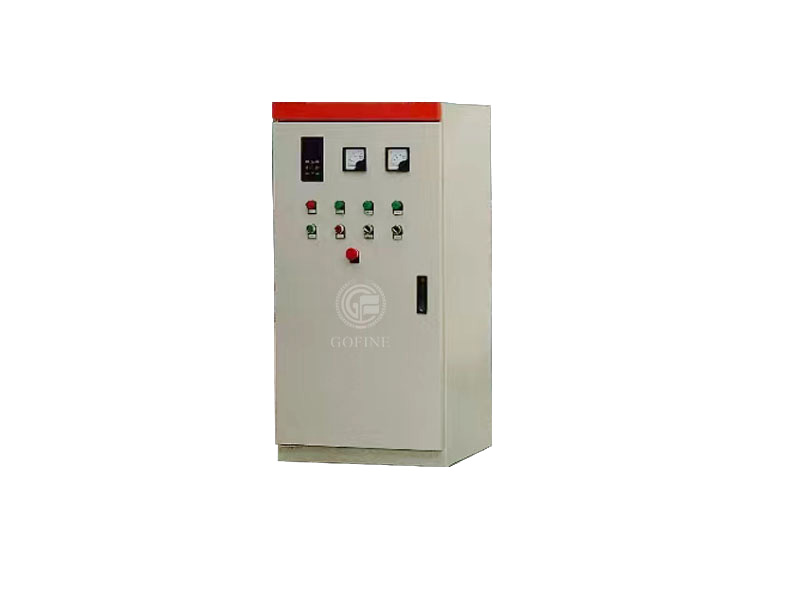
The equipment is equipped with multiple mechanical interlocks and electrical protection devices to ensure the safety of personnel and equipment.

Highly adaptable
The equipment can process various types of ore, from soft limestone to high-hardness iron ore, and is adaptable to both dry and wet processing methods.
Product Inquiry
Related Cases

Contact us
Address: Wulong Industrial Park, Xingyang City, Zhengzhou City, Henan Province
Contact:Richard
Phone:+86 151 3866 6240
Mail:richard@zzgofine.com
Online consultation
Copyright © 2027 All Rights Reserved.